 NZ to Utopia
NZ to Utopia
"All watched over by machines of loving grace." — Richard Brautigan, 1967
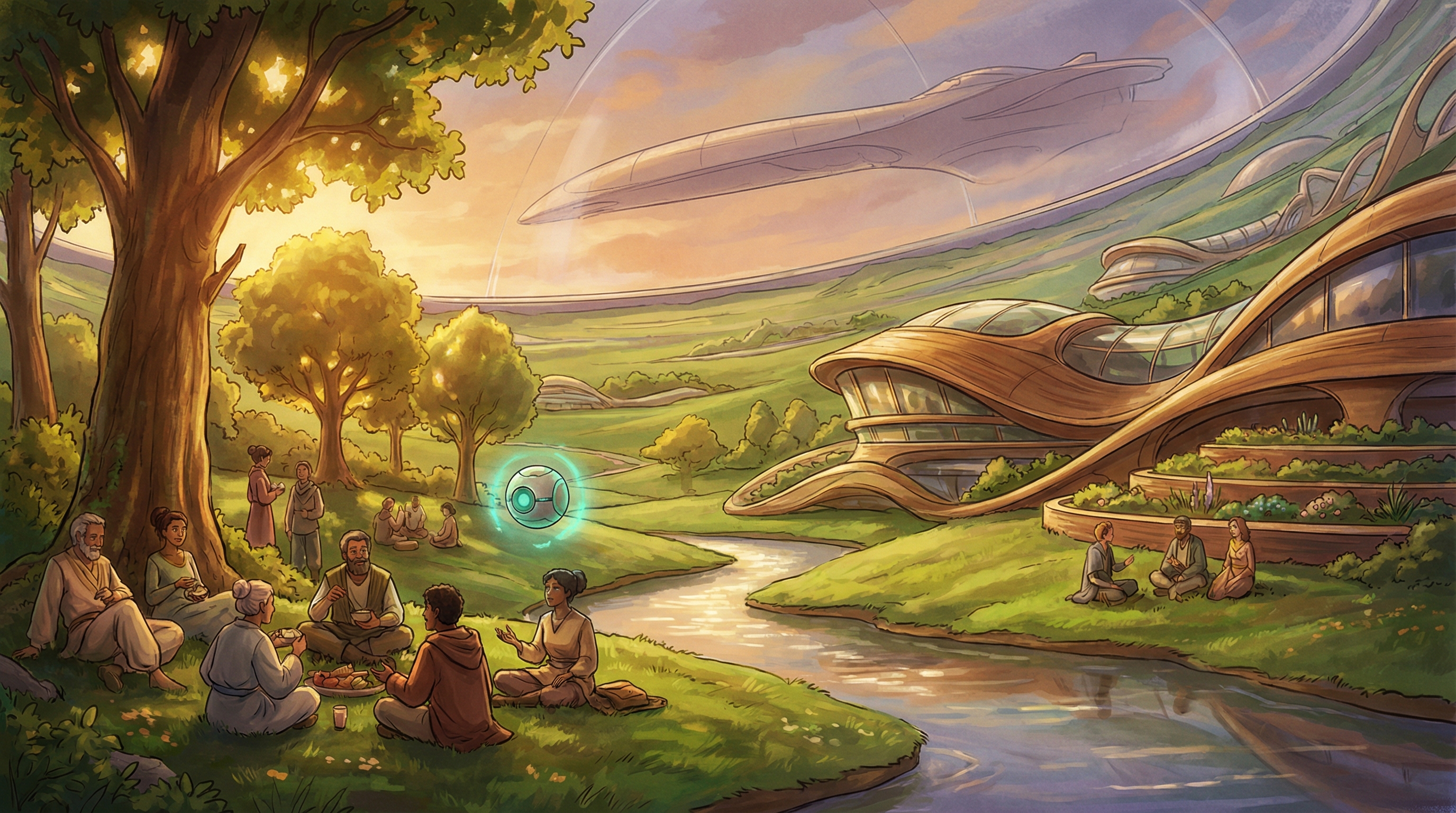 Iain M. Banks in his Culture novels depicted a post scarcity civilisation that we can aim for.
Why this document exists
Aotearoa New Zealand stands at a pivotal moment. Artificial intelligence is reshaping industries worldwide at a pace that outstrips our policy frameworks, our education systems, and our social safety nets. This isn't a future problem — it's happening now.
New Zealand has unique advantages: a small, cohesive population; strong democratic institutions; a tradition of pragmatic social policy; deep cultural values around community (whanaungatanga) and stewardship (kaitiakitanga). We have the opportunity to navigate the AI transition not as passive recipients of disruption, but as active architects of a better society.
This document is an attempt to chart that course.
What this is
NZ to Utopia is a collaboratively-edited policy document — a living blueprint for how New Zealand can move through the AI revolution toward a more equitable, prosperous, and humane future.
It covers:
- Economic landscape — understanding which NZ industries are most exposed to AI disruption, and where the opportunities lie
- Impact assessment — honest analysis of job displacement timelines and emerging roles
- Transition strategies — sector-by-sector plans for adaptation, not just survival
- Education & reskilling — redesigning learning from primary school through lifelong upskilling
- Social safety nets — income support, healthcare, housing, and mental health systems fit for a transforming economy
- Governance & regulation — AI ethics, data sovereignty (including Maori data sovereignty), and international cooperation
- Implementation roadmap — concrete actions phased from 2026 through 2035
How it works
Every section can be edited, challenged, and improved by anyone. You don't need to be a developer, and you don't need to leave the site.
To contribute:
- Read a section that interests you
- Click "Edit in browser" at the bottom of the page
- Make your changes in the editor that opens, write a short note explaining why, and submit
- The community reviews and discusses your proposal
- Accepted changes are merged and published
That's it. No accounts to set up, no tools to install, no git to learn. Just ideas, evidence, and a willingness to engage.
For those who want to go deeper: the document lives in a public Git repository where you can see the full history of every change, follow the debate on past proposals in GitHub Discussions, or work directly with the source if you prefer that workflow.
Ask the Policy Expert
This document is backed by an AI policy expert — a knowledge system built from peer-reviewed academic research on automation, technological unemployment, and transition policy. It draws on findings from researchers like Autor, Acemoglu, Frey & Osborne, and others, surfacing where the evidence agrees, where it contradicts, and what it means for New Zealand.
Click the chat button in the bottom-right corner to ask questions about the policy, the research behind it, or how international evidence applies to NZ's specific context.
Axioms of Utopia
The word "utopia" is in the title deliberately. But what does it mean? These are the fundamental axioms — the non-negotiable principles from which every policy recommendation in this document is derived. They serve as a constitution for contributors: does this proposal serve the axioms?
-
Human dignity is non-negotiable — Technology serves people, not the reverse. No one is disposable because their job was automated.
-
Equity, not just efficiency — AI transition must reduce inequality, not deepen it. Gains are shared broadly across communities, regions, and generations.
-
Democratic agency — People have a say in the systems that affect their lives. AI governance is participatory, not imposed.
-
Ecological sustainability — A prosperous future that destroys the environment is not utopia. AI must serve climate goals.
-
Sovereignty — Aotearoa controls its own AI destiny. Critical systems are not dependent on foreign governments or corporations.
-
Evidence over ideology — Policies are hypotheses, not sacred truths. We test them, measure the results, and adapt. We follow what works.
-
Inclusive by default — Te Tiriti obligations, accessibility, and diverse representation are built in from the start, not bolted on after.
The scientific method for policy
These axioms demand a particular approach to policy-making: the scientific method. Traditional policy is proposed, debated ideologically, implemented, and defended regardless of outcomes. We propose something different:
- Hypothesise — State what you believe a policy will achieve and why
- Simulate — Where possible, model the outcomes before real-world implementation
- Pilot — Test at small scale in specific regions, sectors, or populations
- Measure — Collect data against pre-defined success metrics, published openly
- Adapt — Double down on what works, modify or abandon what doesn't, begin the next cycle
This framework is baked into the Implementation Roadmap — policies are phased as hypotheses to be tested, not mandates to be enforced.
A note on scope
This document focuses on domestic policy for New Zealand. While we reference international developments and best practices, the goal is a plan tailored to NZ's specific context — our industries, our people, our values.
We don't claim to have all the answers. Many sections are marked as drafts, indicating areas that need more research, more voices, and more debate. That's by design. The document improves through contribution.
Getting started
Use the sidebar to navigate between sections, or continue to the Economic Landscape for an overview of New Zealand's current industries and their AI exposure.